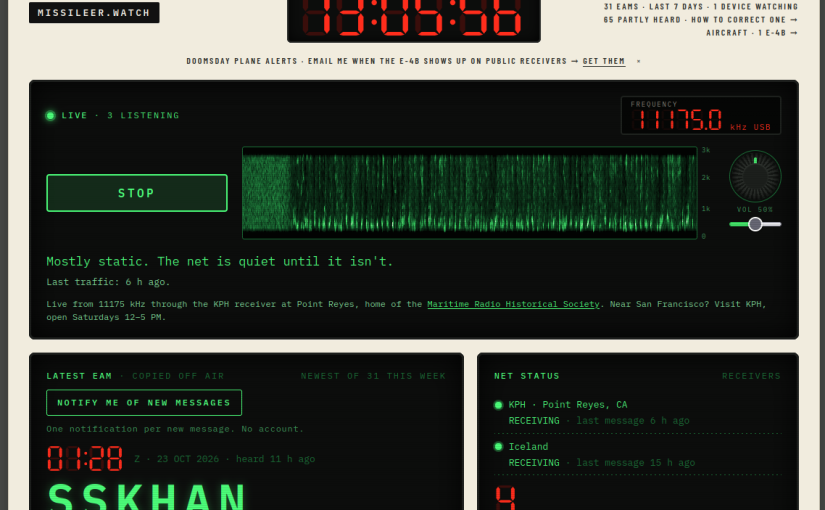
As a former cold guy, this brings back a bit of nostalgia. The Air Force operates something called the HFGCS (High Frequency Global Communications System) which has transmitter sites around the world and uses multiple frequencies. This system augments the satellite based system that is mainly used. The beauty of HF voice is it is a transmitter and a receiver. No internet, data modems, network switches, routers, etc. Moderate power levels can be heard half a world away in real time.
Call Sign
Base
State/Territory
Country
Comment
Anderson
Anderson AFB
GU
US
Andrews
Andrews AFB
MD
US
Net Control
Ascension
RAF Ascension
Ascension Is
UK Overseas
Croughton
RAF Croughton
Northamptonshire
UK
Diego Garcia
USN Base
Diego Garcia
UK Overseas
Elmendorf
Elmendorf AFB
AK
US
Hickam
Hickam AFB
HI
US
Lajes
Lajes Field
Azores
Portugal
West Coast
Beale AFB
CA
US
Receive only
Offutt
Offutt AFB
NE
US
Puerto Rico
Salinas
PR
US
Sigonella
NAS Sigonella
Sicily
Italy
Yokota
Yokota AB
Honshu
Japan
List of voice frequencies used (KHz):
4724
8992
11175
15016
Messages are proforma and encrypted using a one time pad which is unbreakable.
If you are interested in a bit of military history, head on over and check it out.
An important part of any medium-frequency and high-frequency antenna system is the nature of the ground immediately around the antenna system. The reason for the complex and expensive AM ground system is to create a return path for the portion of the RF wave that is not radiating from the tower. Higher ground conductivity helps this process greatly. The higher the ground conductivity, the more efficient the antenna will be.
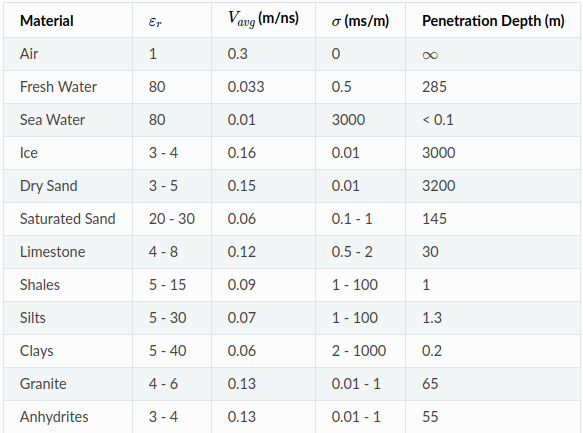
Ground permittivity is relative to that of free space which is 1. In general, it is a measurement of how much polarization of the ground material occurs in the presence of an electric field. Relative permittivity is a unit-less number indicating the dielectric constant. It is an important factor in ground wave propagation modes like daytime AM radio. Lower frequencies have greater depth of ground penetration and permittivity goes up. That is why low dial position AM stations have better daytime ground wave coverage per kilowatt then the high dial position stations.
Estimated relative ground permittivity by composition, Courtesy of em.geosci
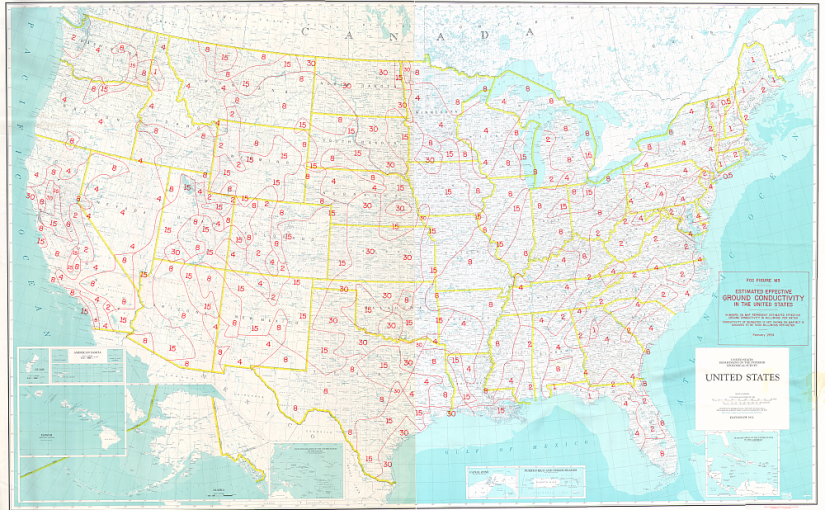
According to the FCC M3 map, the ground in this general area is supposed to average 4 milliMhos per meter (milliMho is equivalent to a milliSiemen). This is a very rough estimate as conductivity can vary greatly within short distances and can change depending on soil moisture. This is the reason why many AM transmitter sites were built in swamp land. Wet soil has higher conductivity and permittivity. Plus, the land was cheaper.
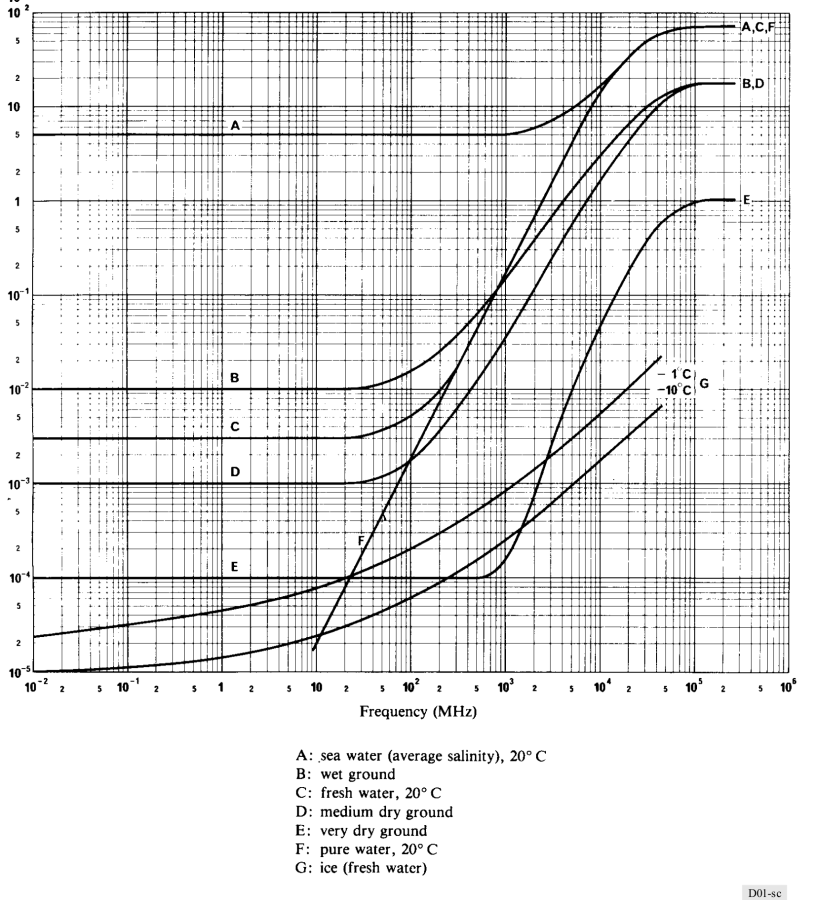
Estimated ground conductivity by frequency and moisture, ITU recommendation P.527.3
When modeling antennas with NEC, particularly vertical antennas, the ground conductivity plays a significant part in the antenna performance. At lower frequencies, the permittivity (aka dielectric constant) also plays a role. Having actual numbers instead of the FCC estimate gives a better overall model of the antenna.
All of this made me think about how to obtain better data. Fortunately, a radio amateur (Rudy Severns, N6LF, Hardy Lau, DL1GLH and Tobias Wellnitz, DH1TW) have thoroughly documented a good procedure. This is termed “Open Wire Line” method, which uses two metal probes that are the end of an Open Wire transmission line. A VNA is then connected to the probes and the complex impedance is measured. The resistance and reactance are then plotted along with the physical aspects of the probes to calculate conductivity and permittivity. More information can be found at How to measure Ground Conductivity by Tobias, DH1TW.
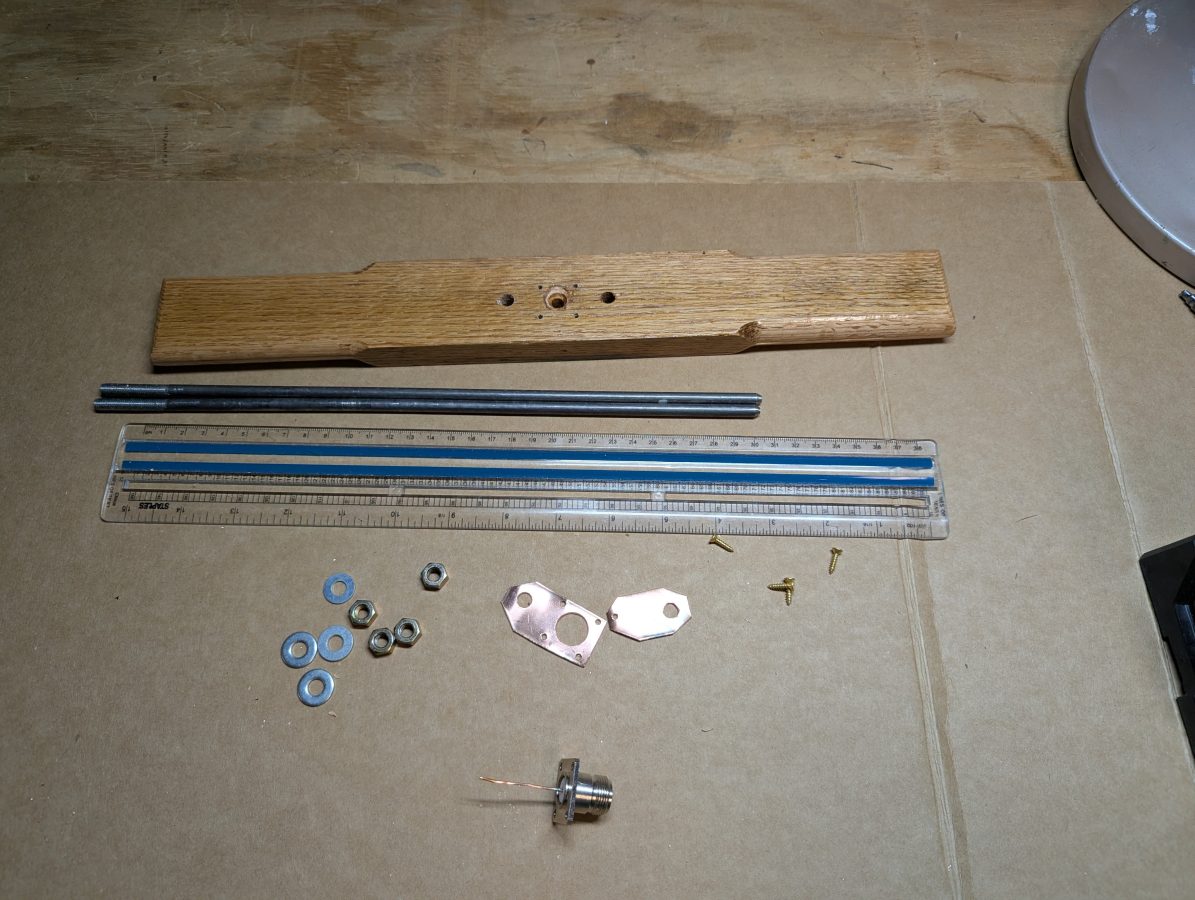
Ground conductivity probe parts
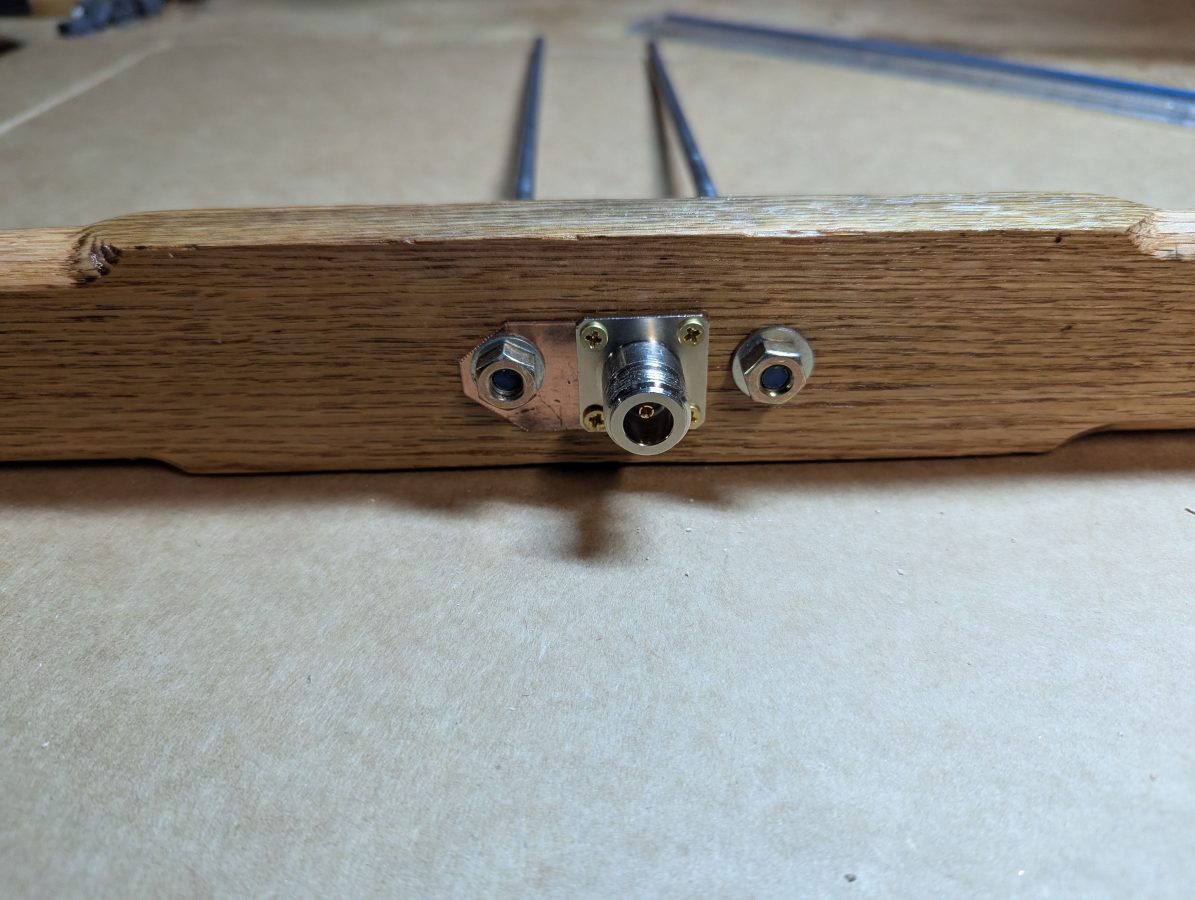
Once again, I took stock of what I had laying around and found a pretty good way to make a ground conductivity probe. The first thing is to make an insulated holder/handle for the two metal probes. I have a large selection of oak planks, which have been used for many projects in the past. In this case, a small piece of 1 x 2 was cut down to 16 inches. I then used the router to round off the edges and laid out the holes for the probes and N connector. I finished the oak with several coats of polyurethane to keep moisture out of the wood grain. I purchased a three foot piece of 1/4 inch (6.35 mm) mild steel round stock, which I cut in half. Using a 1/4 28 die, I threaded one end of each piece so I could attach it to the oak handle. The probes are spaced 50 mm apart and are 300 mm long. The steel probes were connected to the N connector with two pieces of copper strap.
Name
Quantity
Use
Cost
Comment
Oak 1 x 2″
`1
Handle
$0
Left over
1/4 x 36″ steel round stock
1
300 mm probes
$6.99
Home Depot
1/4 28 nuts
4
Attach probe to handle
$3.99
Home Depot
N Female Connector
1
RF input
$0
Salvaged
Copper Strap
5 inches
Connect probes to RF input
$0
Left Over
Ground conductivity measuring probe
The land around my house was farm land for a long time. First field crops then a grazing pasture for a dairy farm. The last farming activity was about 65 years ago, since then the trees have grown in. The soil itself is mostly glacial till; rocks, sand and clay. I do not expect much.
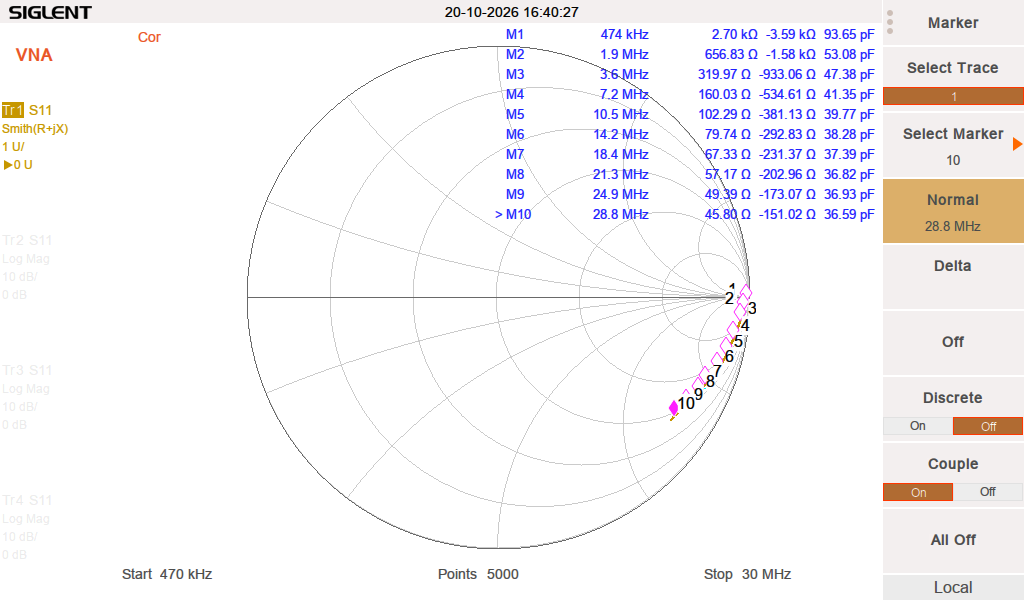
I headed into the woods with my Siglent network analyzer and measure the ground conductance. I then saved that information as a .csv.
Amateur Bands OWL measurements
I have since saved my ground conductivity sweep profile in the analyzer. I reduced the points down to 180, which gives at least one point in every amateur band from 630 through 10 meters. That makes the marker settings redundant and .csv output much more manageable. I have another sweep profile for just the AM Broadcast band, this one runs from 530 – 1,710 KHz and has 118 points, which provides a measurement on every carrier frequency.
I sent the .csv into ChatGPT and had it analyze the data. When it comes to AI, it is all about the prompt. The more information and instruction provided, the better the output will be, usually.
The ChatGPT prompt:
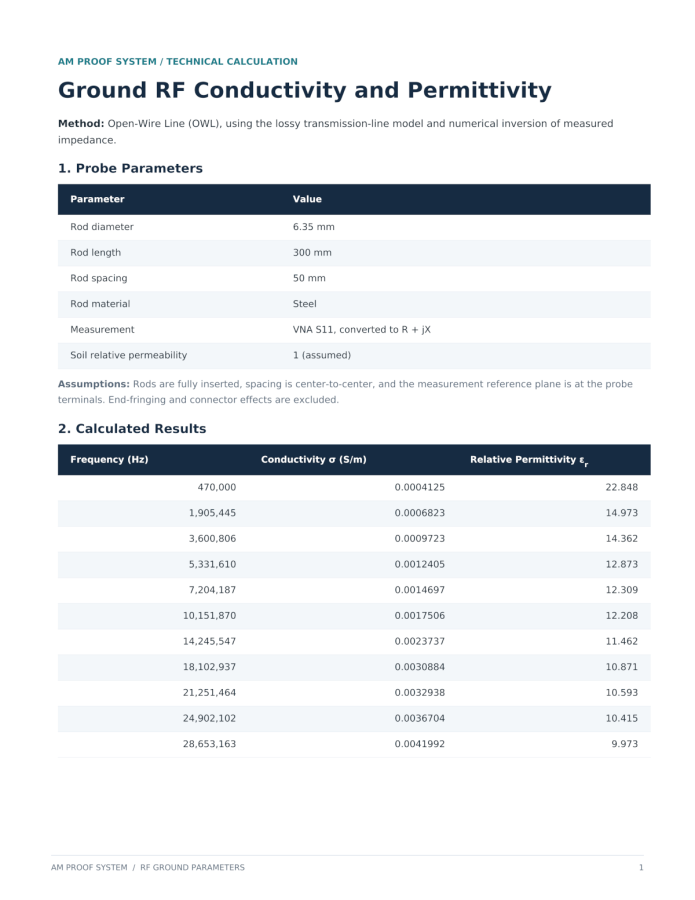
Calculate the ground RF conductivity and permittivity using the open wire line method. Measurements are made with a Vector Network Analyzer using S11, data is Real/Imaginary, ground measurement probe consists of two steel rods, 6.35 mm in diameter, 300 mm long, spaced 50 mm. The rods are fully inserted into the ground. Include probe end fringing and steel conductor losses. Show all math and proof for the first frequency only. Use this data: cgmfhf1.csv
I have found a need to be careful with any AI. ChatGPT tends to be over optimistic. My first attempt, the output had a ground conductivity of 12 mS/m which looked great until I dug a little deeper. It seems ChatGPT copied the answers from DH1TW’s blog post. When I ran the numbers myself, it was more like 1 mS/m. I scolded that lazy AI and told it to do it again, this time with the proof. That is why I want to see the math for the first frequency. Here is a chart with the ground conductivity and permittivity in my antenna field for the MF and HF amateur frequencies:
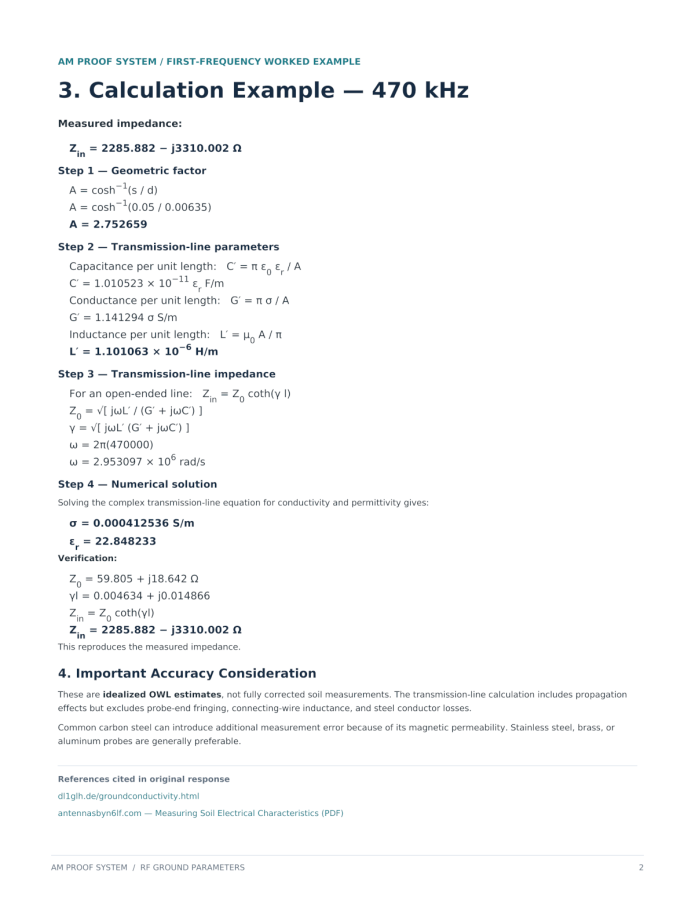
Here is the math for the first frequency:
I always ask to see the math for the first frequency so I can check the AI’s work and make sure that it is not being lazy again.
Running some models in MANNA-GAL and I feel like the results are much more similar to what I am seeing WSPR beacon.
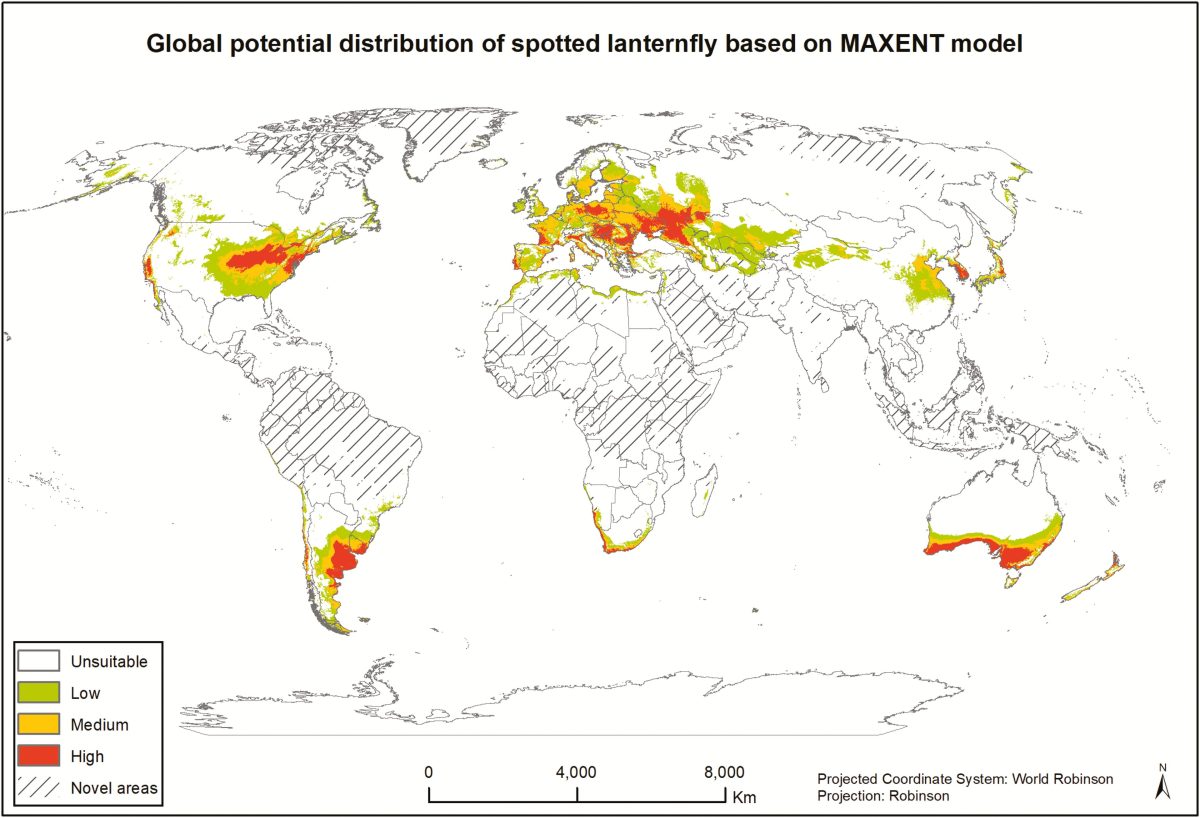
The topic today; Lycorma Delicatula, AKA The Spotted Lantern Fly. These little plant hoppers are native to China and Vietnam and were accidentally imported to the US back in 2013 or so. They were first spotted in Pennsylvania in September of 2014 They are destructive and invasive. Now, found in the Mid Atlantic and Mid Western parts of the United States as well as other areas, they are devastating to native flora. In upstate NY, the grape industry is being especially hard hit.
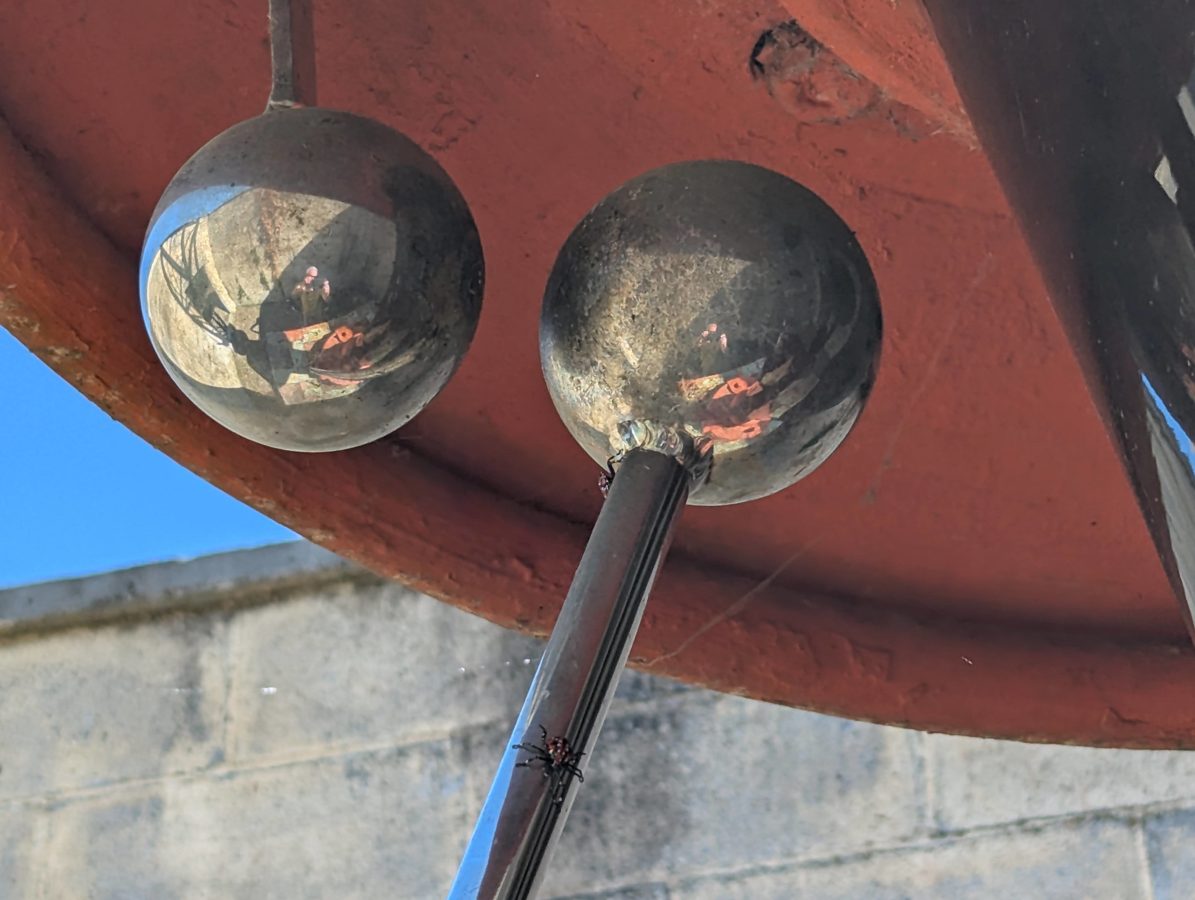
So, what does this have to do with broadcasting? Great question. Recently, on one of the AM sites we take care of, I noticed several VSWR trips during the late afternoon. Coincidentally, a landscaping company came and chopped all the vegetation around the tower base. That is when I saw it. These little things were crawling up to the ball gap and getting zapped.
Spotted Lantern Fly Nymph crawling on ball gap
The best and only course of action when finding these things is to terminate their existence with extreme prejudice. I have a few grape vines around the homestead and I found that making them hop off an land in the grass is the easiest way to kill them. For some reason, the grass tends to make it difficult for them to hop away. The female bugs are larger, so I tend to concentrate on those first.
They have few natural predators in the US, although that seems to be slowly changing. There are a couple of fungi that seem to kill them and birds such as Robins are discovering them. Eventually, they will find their place in the food chain and become less of an issue. Hopefully, that happens sooner rather than later.
This post is about a Large Loop On Ground (LLOG) receive antenna.
I have, for some time, been lamenting the demise of my K9AY antenna last year. While I don’t spend a lot of time Shortwave Listening these days, it is sometimes a nice diversion on a rainy day.
I have been reading about LOG (Loop on Ground) broadband receive antennas for a few years and the concept sounds interesting. Loop antennas in general, tend to reject RF noise better than dipole or vertical ground plane type receivers.
The idea is the loop antennas are more H field (magnetic) than E field (electrical) receivers. Most unintentional RF noise generators create noise in the E field.
Near Field vs. Far Field Electro-Magnetic energy
Additionally, close proximity to the ground further lowers E field noise due to capacitive coupling with the ground. The ground acting as a sink for the E field noise. Loops also tend to have better rejection of chaotic Near Field energy. Thus the combination of those three things will create slightly lower signal with much better signal to noise ratios over traditional up in the air antennas.
The downside is that it cannot be used for transmitting. The capacitive coupling noted above will quickly dissipate all of the transmitted RF into ground as heat.
The LOG antenna that most amateur radio operators use is either or close to the antenna outlined by Matt, KK4JY: The Loop on Ground Antenna
That is all well and good, but I want something larger to go down through the entire Medium Frequency band in into Low Frequency range. The main reason is I want to start fooling around with the 2200 and 630 meter amateur radio bands. Also, wanting a good low noise AM broadcast receive antenna. With that in mind, I began taking inventory of available real estate and parts.
As for real estate; I own a patch of woods behind my house that is approximately 200 x 200 feet. Good enough for a fairly large square loop. The good thing about particular plot of land is it is far away from the neighbors, the utility lines and other sources of electrical noise.
As for the available parts; it turns out I had almost everything needed. The only thing I needed to purchase is a water tight outdoor enclosure for the matching transformer, from Amazon for $9.00.
Here is a list of items used:
Item
Amount
Use
Comment
Cost if new
Wire, 14 AWG
470 feet (143.26 M)
Wire Loop
Pieced together from left overs
$100.00 (500 ft spool) at Home Depot
Toroid, BN-73-202
1
Transformer core
Left over
$0.95 at Amidon
Wire, 26 AWG magnet wire
18 inches (46 cm)
Transformer winding
Left over
$9.00 (2 oz) at Amazon
Coax Cable, Cablewave FCC38-50J
175 feet (53.34 M)
Transmission line to house
Salvaged from decommissioned AM directional
$53.00 (500 ft spool RG-6) at Home Depot
RF Connector, type N Female
1
Antenna output
Found in junk drawer
$6.00 (6ea) F chassis mount at Amazon
Enclosure, ABS water tight IP67
3.9 x 3.9 x 3 inch (9.9 x 9.9 x 7.62 cm)
Transformer housing
Purchased from Amazon
$9.00 at Amazon
The wire is copper THHN 14 gauge. If buying new, this is the single largest expense. I soldered and heat shrunk several lengths from left overs on spools. This antenna is going to be in the shade, so I don’t have to worry too much about UV degradation of the insulation. If that happens, I can find some more insulated wire.
The big bonus is the Cablewave FCC38-50J phase stabilized cable, most of which is buried out to my old K9AY antenna, I simply extended it about 50 feet. Having the line already buried to much of the manual labor out of the project. The buried section of line acts as an RF choke, fully eliminating any electrical noise coming from my house at the antenna side of the line.
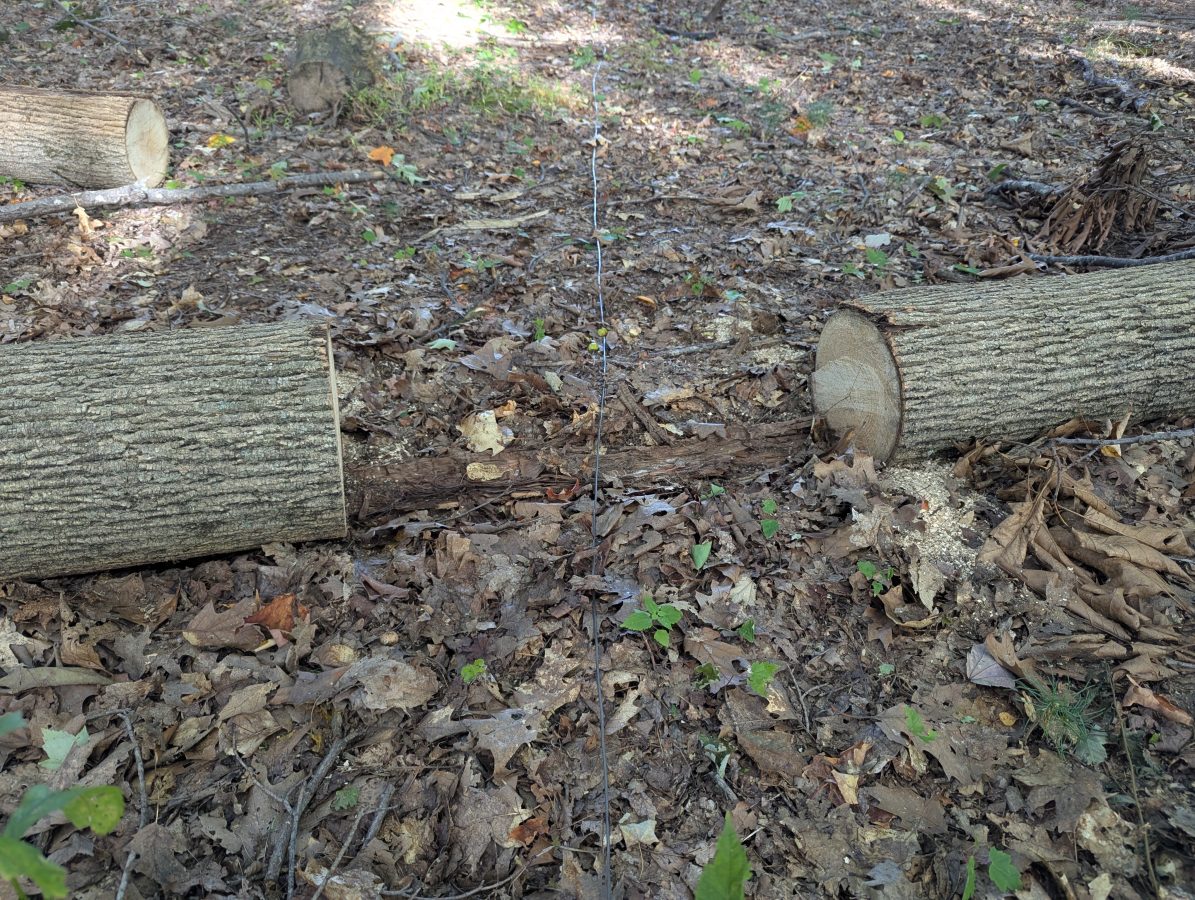
Large Loop On Ground antenna, installed in woods behind my house
I did have to go around and clear away some brush and dead trees along where the antenna wire was laid on the ground. I wanted to make sure that the wire was directly on or within an inch or two of the ground.
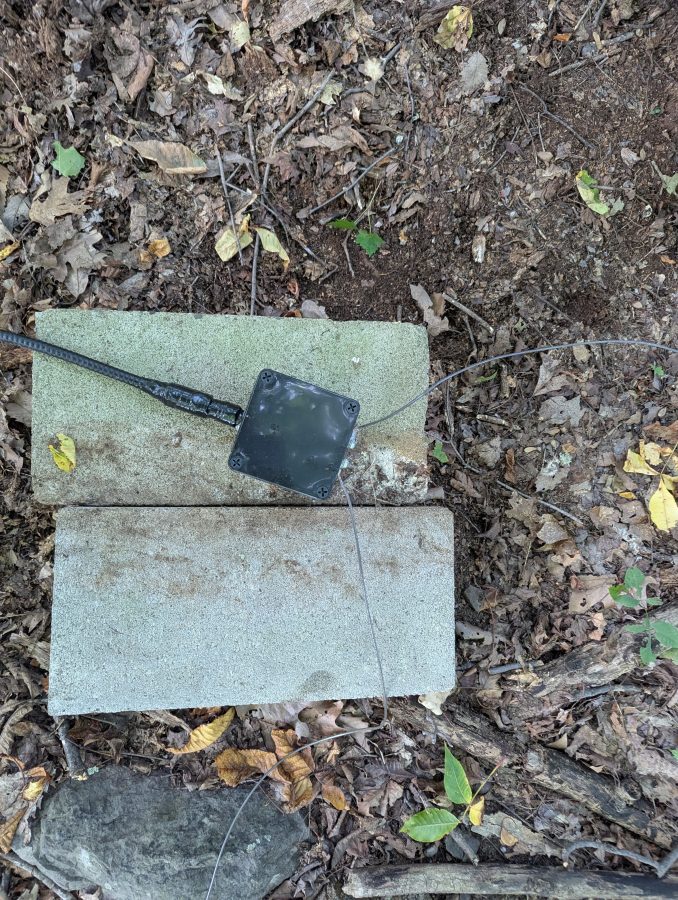
LLOG antenna transformer and transmission line
The transformer took about 20 minutes to construct. It consists of six windings on the antenna side and two windings on the transmission line side. I used a type 73 core because I am more interested in the medium frequency range. It seems to work well up to about 15 MHz. The transformer is for galvanic isolation, keeping the loop current balanced and separated from the transmission line. The shield is not grounded at the antenna side, but is grounded where it comes into the house. On the transformer enclosure, I used a salvaged N connector to match what I had for the transmission line. Any low loss cable, including RG-6 or RG-11 will work very well.
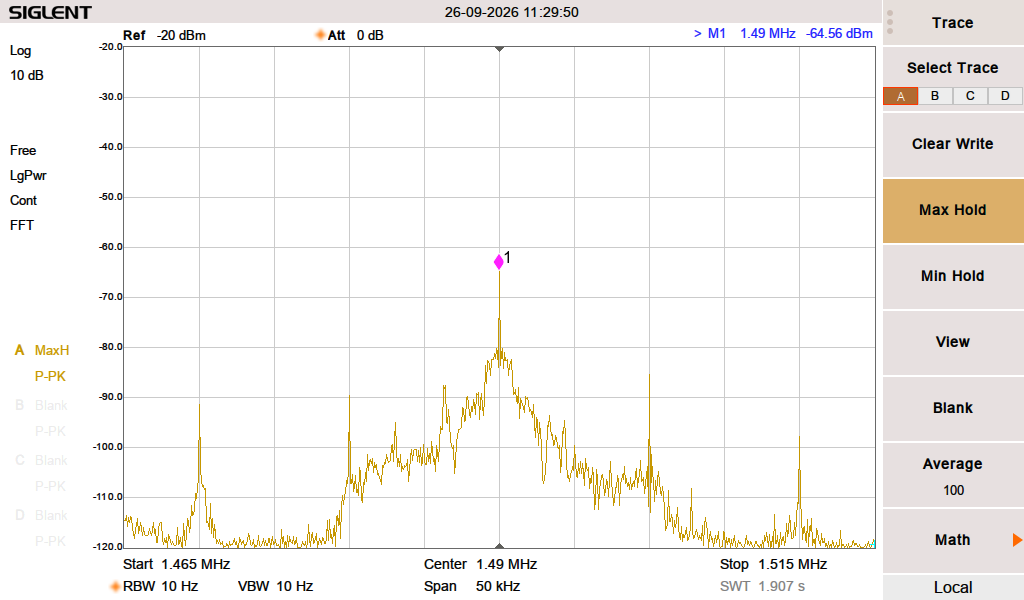
WKNY signal, 18 miles distant from transmitter
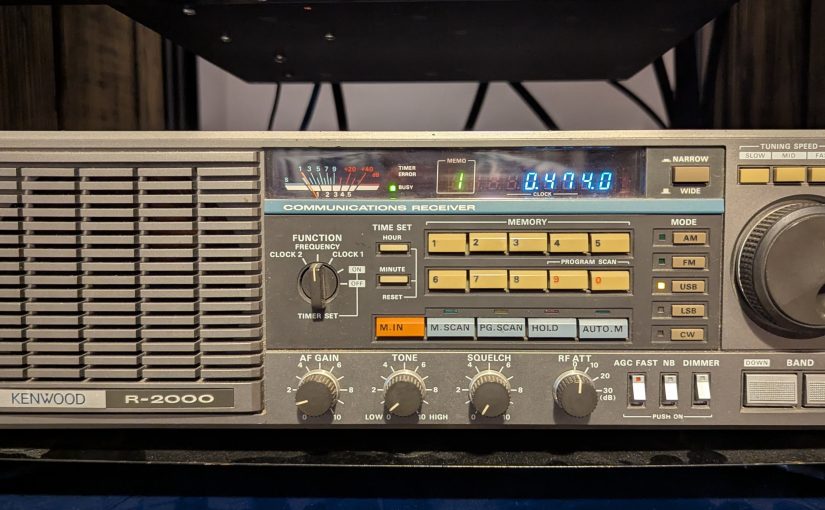
After a few hours of low intensity work, I had everything together. I connected the antenna to my trusty Kenwood R-2000 receiver and tuned to the nearest Class C AM on 1,490 KHz. Wow! What a difference! This little 1 KW high band station 18.6 miles (30 km) away barely came in before, especially when the ground is dried out. The relative signal strength meter on the receiver shows an S9+5. I am located on the edge of the predicted 0.5 mV/M contour while the spectrum analyzer shows a -65 dB signal, which is netting a 44 dB SNR, which is very good. All of this is after a Mini Circuits ZSC-4-2 power divider, which has an insertion loss of -6 dB per port.
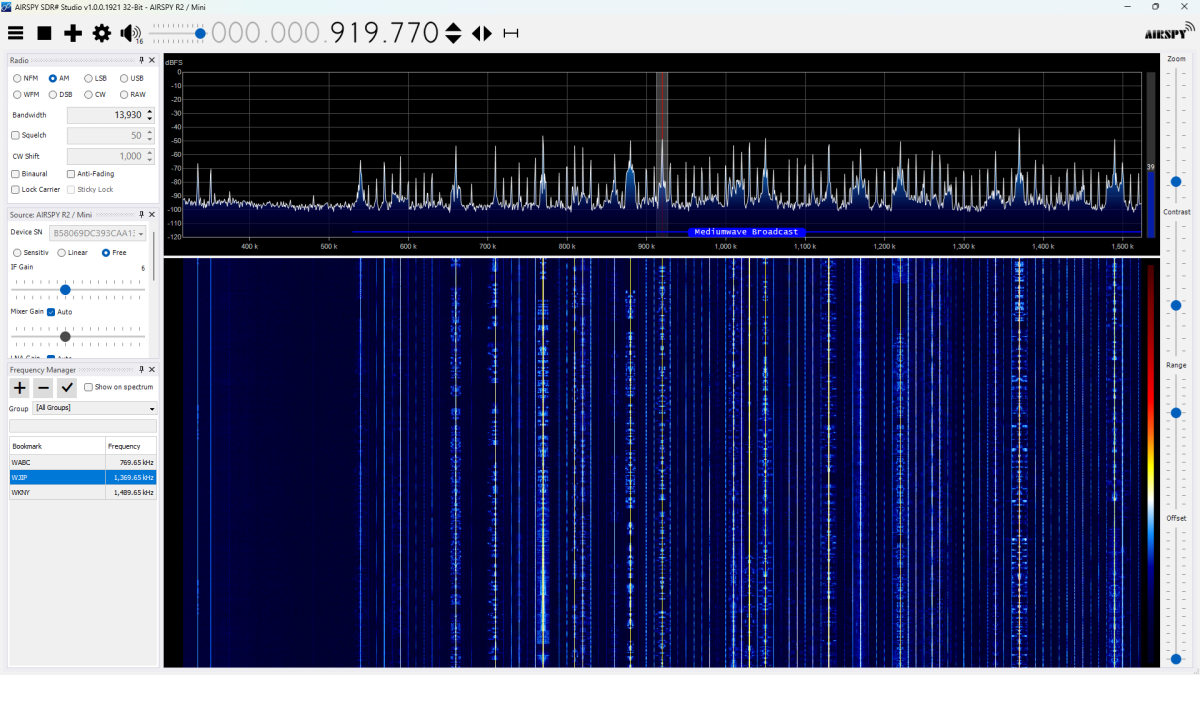
Wide view of the entire AM band, about 1pm
One of the reasons for the “decline of AM;” overcrowding. This was taken during the daytime, when there was no skywave propagation. Barely an open frequency.
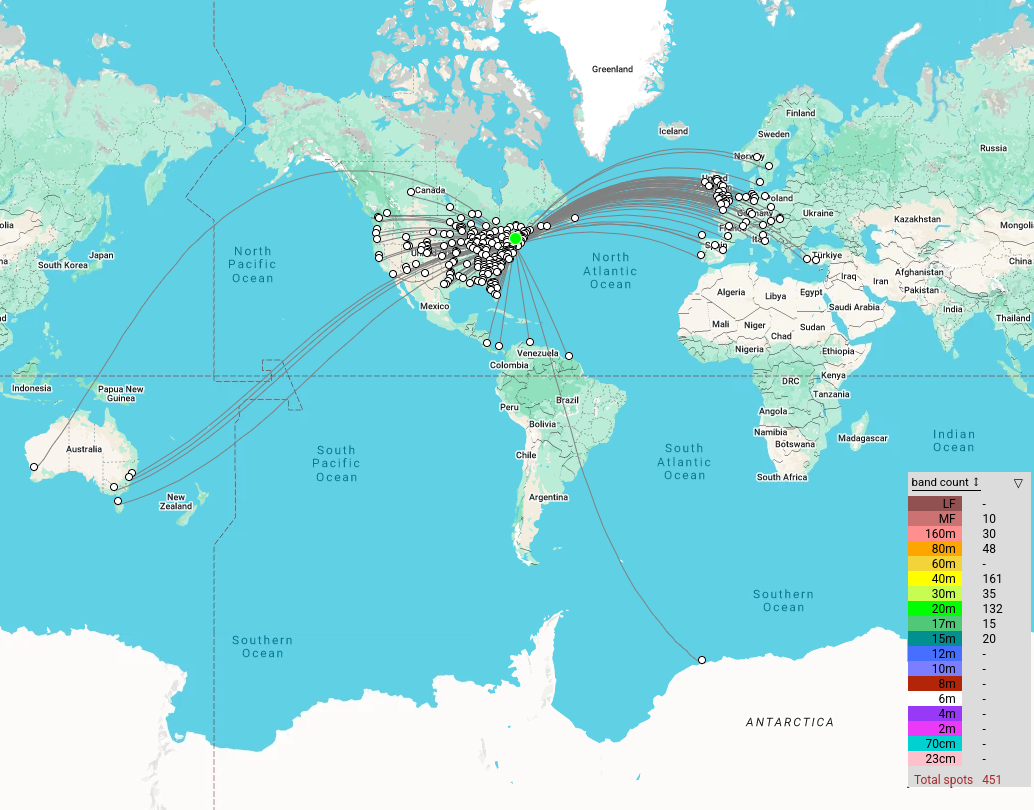
With the spectrum analyzer and made a few interesting discoveries. First, the noise floor in the Medium Frequency range goes from about -100 to -110 depending on the frequency. The noise floor on High Frequency is -112 or lower across the entire band. I clearly get all of the NYC AM stations as well as most of the stations in and around Albany. Before sunrise, I tuned around the 630 (472 to 479 KHz) meter band and heard a few stations sending CW (W4TS @ 164 miles (264 KM), K2ORS @ 157.2 miles (253 KM)). A few overnights of WSPR monitoring on 475.6 KHz netted 194 spots from 11 different stations. The furthest was 822 miles (1,322 KM) away in central Illinois. All of these stations are transmitting 5 watts EIRP or less.
LLOG 72 Hour WSPR reception map
This antenna works well to about 15 MHz, where the signals start to drop off because of the transformer material that I used.
Using the Network Analyzer, I found the resonance is 2.865 MHz with a -36 dB return loss. This makes sense, as the wire laying on the ground will have a lower velocity factor due to the capacitive coupling with the earth. In this case the VF of the antenna is 73% when the soil is dry. The velocity factor should go down when the ground gets wet, or covered with snow.
It might be interesting to do some ground conductivity measurements…